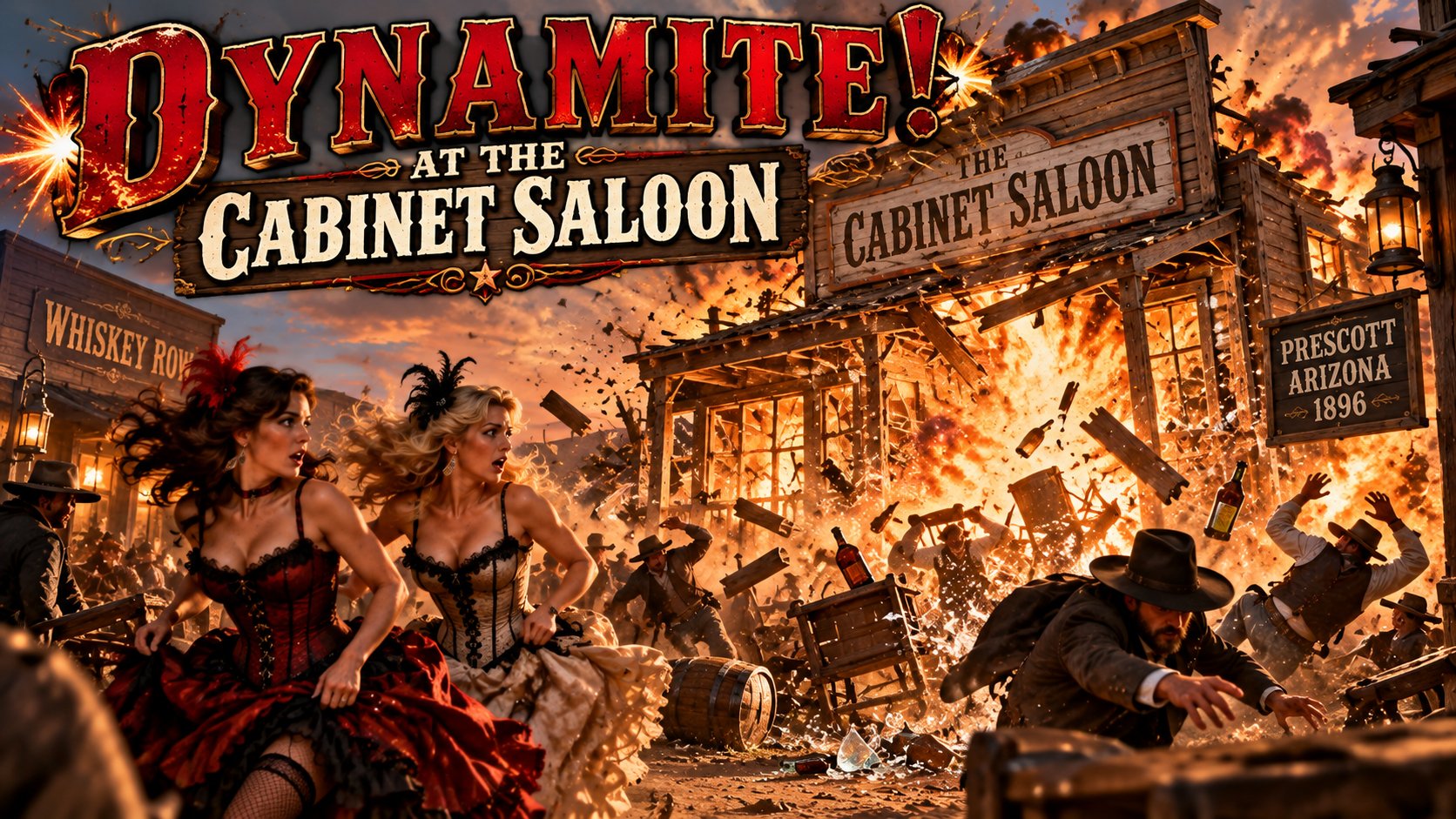
It sounds like something straight out of a Hollywood Western: a jealous husband, two women having dinner, six sticks of dynamite, and an explosion that shook an entire frontier town. But the story behind “Dynamite at the Cabinet Saloon” actually happened on a Sunday night in Prescott, Arizona Territory, in 1896.
Whiskey Row
Prescott was a thriving frontier town, filled with miners, cowboys, gamblers, merchants, and fortune seekers. Along Montezuma Street stood the famous Whiskey Row, where saloons offered everything from poker games and whiskey to fine dining and lively entertainment. Among the most popular establishments was the Cabinet Saloon, a gathering place where respectable businessmen and rough-and-tumble characters of the Old West often crossed paths.
On the evening of June 28, at approximately 9:40 p.m., two women, Bertha Hovey and her friend Cora, were enjoying dinner in the rear dining room of the Cabinet Saloon. Both women were known around Granite Street, an area associated with Prescott's houses of prostitution. Neither suspected that someone had placed enough dynamite beneath their table to demolish much of the room.
A Jealous Husband
The man responsible was William Binkley, a miner who worked at the Last Chance Mine in the nearby Walker mining district. Binkley had married Bertha, only to discover afterward that she apparently had another husband still living in Colorado. Their relationship deteriorated, and according to historical accounts, Binkley became increasingly jealous and resentful as Bertha rejected his attempts at reconciliation.
Eventually, jealousy turned into a murderous plan.
Familiar with explosives from his mining work, Binkley obtained six sticks of dynamite, three feet of fuse, and a blasting cap. On the night of June 28, he learned where Bertha was sitting inside the Cabinet Saloon. He entered the cellar beneath the dining room, positioned the explosives directly below her table, lit the fuse, and escaped to the nearby Royal Saloon.
The Explosion
Moments later, a tremendous explosion rocked Whiskey Row.
The blast shattered windows, ripped apart floorboards, overturned furniture, and demolished the dining room. The noise could be heard throughout Prescott, sending hundreds of startled townspeople rushing toward the wreckage.
And then came the astonishing part of the story.
Despite sitting almost directly above the explosion, Bertha, Cora, and their Chinese waiter survived without life-threatening injuries. A contemporary newspaper suggested that heavy linoleum covering the floorboards may have helped protect them from the blast. Whatever the explanation, their survival seemed nearly miraculous.
Justice on the Frontier
Prescott Police Chief Steve Prince began investigating. Suspicion eventually centered on Binkley, whose troubled relationship with Bertha was already known. On July 19, Binkley confessed.
He also revealed another disturbing detail. He had originally considered dying alongside Bertha and had carried laudanum, a powerful opium-based preparation, intending to take his own life if she died. When he discovered she had survived, he abandoned that plan.
Binkley was convicted of attempted murder and sentenced to ten years in the Yuma Territorial Prison, although he served only about three years. Following his release, he remarried and eventually fathered eight children with a later wife. He died in 1928.
The Cabinet Saloon's owners, Ben Belcher and Barney Smith, repaired the damage and reopened within a month. The saloon continued operating until the devastating Whiskey Row fire of 1900. Its history eventually became intertwined with that of the Palace Saloon, which remains a famous Prescott landmark.
More than 130 years later, the Cabinet Saloon explosion remains one of the stranger episodes of Arizona's frontier history. It had all the ingredients of an unforgettable Western tale: love, deception, jealousy, revenge, and an extraordinary escape from death.
And that is the true historical event that inspired the Six String Gunslingers song, “Dynamite at the Cabinet Saloon.”